Citrine is a gemstone everyone has heard of, particularly because it’s the birthstone for November. Being both relatively affordable and available, it is the best selling yellow tone gemstone in the market. But do you really know all there is to know about this sunshine gem?
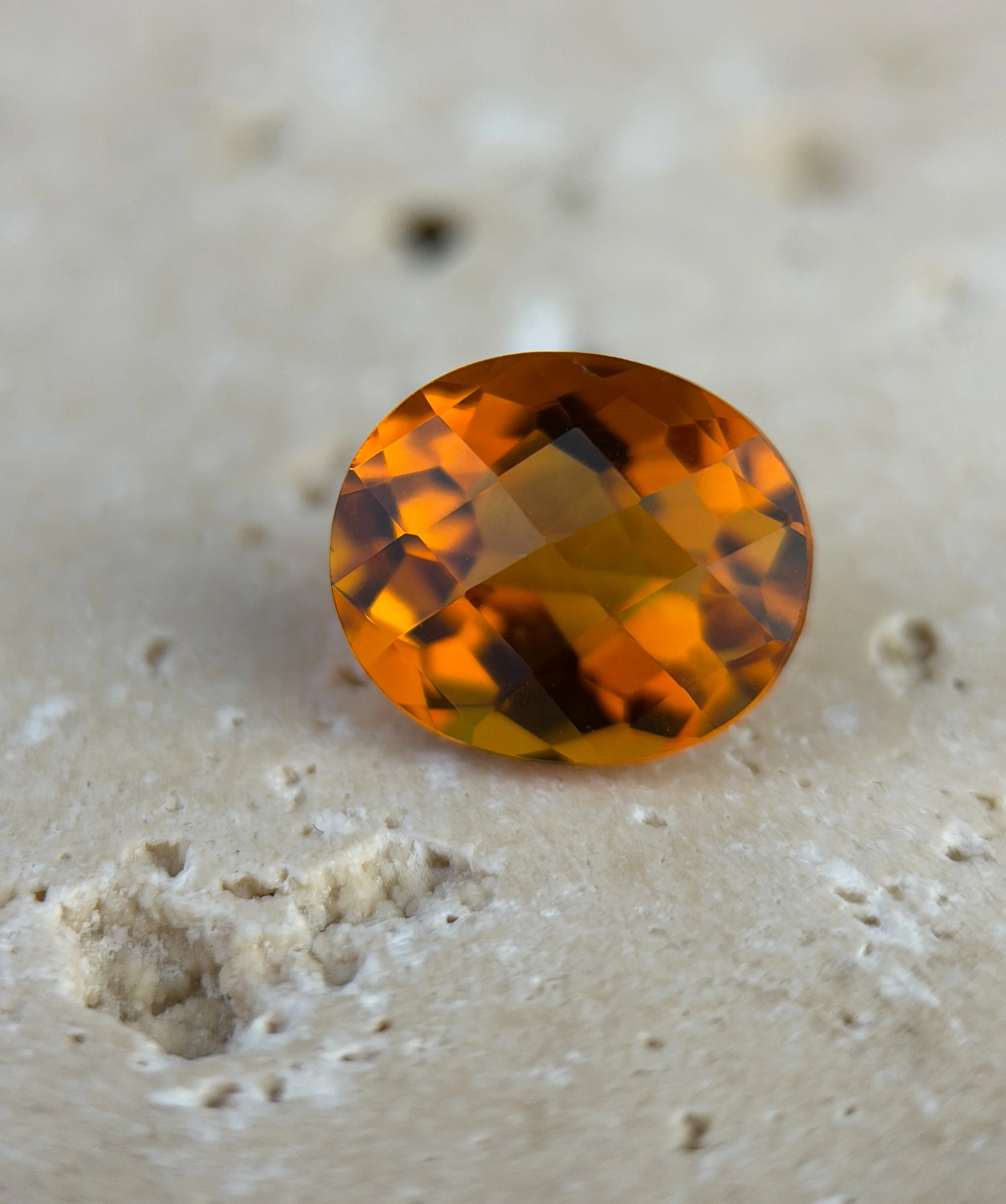
Oval Citrine, 2.4ct, Brazil - photo & gemstone Artisan Jewelry Creations
Citrine is a variety of quartz (SiO2) and is therefore a member of the family comprising the second most abundant mineral in the Earth’s crust. Quartz comes in different types based on crystal size, from macrocrystalline to microcrystalline to cryptocrystalline. Citrine is of the macrocrystalline type - a single crystal large enough to see with the naked eye. Citrine’s color range is from pale to strong yellow, yellowish orange to reddish orange, and reddish brown. Reddish colors are the rarest. When buying, also look for citrines without color zoning or visible inclusions.
With a Moh’s Hardness of 7 it’s durable enough for everyday wear, but less durable than diamond or sapphire. It is typically transparent to translucent. It has a very long history of use in jewelry. You can find it in pieces ranging from royal jewelry, to high end red carpet pieces, to classic everyday wear.
Citrine Through History
The word “citrine” was first used in English in the 14th century, first for a color (adjective) then as a noun. However, the gemstone has been around for much longer than that! It was used as a decorative gem in Ancient Egypt (from 3150 B.C.) associating it with the Sun god Ra. In the Hellenistic Age of Ancient Greece (323-30 B.C.) and through the time of the Romans (xxx) it was used for both decoration and religious associations. From the late 18th century citrine and other quartz varieties were mined in Scotland’s Cairngorm Mountains. These gemstones, popularly known as Cairngorms, were used to decorate weapons, accessories of Highland dress (broaches & pins), and were set into luxury boxes.
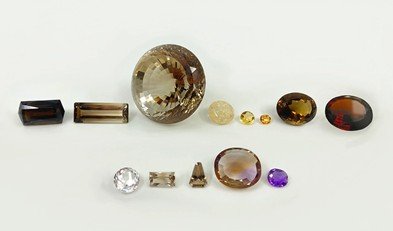
Scottish quartz gemstones showing the range of possible colors – the 3 to the right of the largest gem (yellows), and the rightmost gem on the back row (reddish orange) would all be considered citrines. Photo from National Museums Scotland
During a stay at the Scottish Balmoral palace in1851, Queen Victoria was gifted a 50lb brownish quartz crystal by local man James Grant. James found the quartz in what is now the Cairngorms National Park and carried it to Balmoral on horseback. He was rewarded with £50 (about £3,700 or $4986USD today). In 1852, Queen Victoria and Prince Albert acquired Balmoral and built a new castle on the grounds as a royal retreat. Her love of the Scottish Highlands influenced the building and subsequent decoration of the new estate. The style created a popular "highland" aesthetic” which influenced how British aristocracy and later, the general public, dressed for country leisure. The warm browns and yellows of Cairngorms (citrine & smokey quartz) played important roles in this aesthetic.
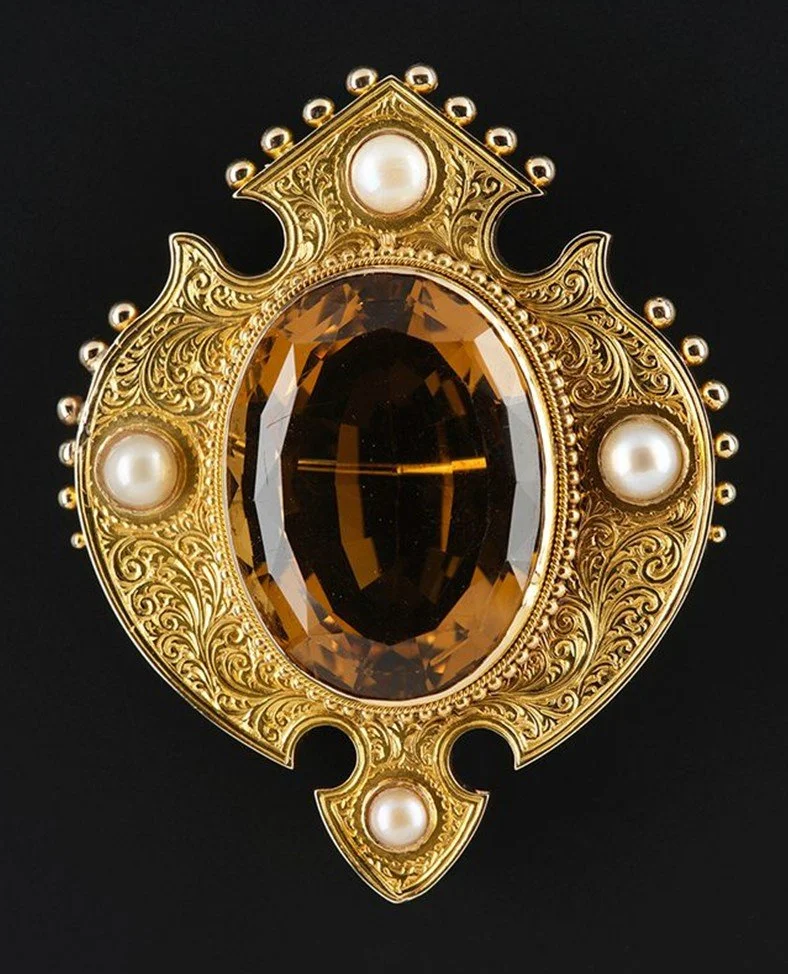
Brooch made from native gold sourced in Sutherland, set with a central cairngorm stone and surrounded by four Scottish freshwater pearls, by Glasgow jewellers Muirhead & Son, c. 1868-1873. Photo from National Museums Scotland
In the 1930s, a group of experienced gem cutters started shipping large quantities of gemstone grade citrine from South Africa to Europe (Germany) for cutting and fashioning into jewelry. The increased availability, and the expert cutting of the stones resulted in a rise in popularity. The Art Deco jewelry movement began soon after, and new designers started creating elaborate citrine focused jewelry which gained significant traction in Hollywood and with the wealthy in major metropolitan areas for its bold, glamourous color.
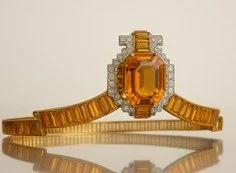
Cartier London Citrine and Diamond Tiara - Created in 1937 for the coronation of King George VI. 62.35-carat, emerald-cut citrine, framed by old- and baguette-cut diamonds, with rows of calibrated baguette-cut citrines along its gold and platinum frame. The tiara’s central element can be detached and worn as a clip-brooch. Victoria and Albert Museum permanent jewelry collection, London.
Today, citrine is mostly known as the November birthstone (along with topaz) and the gemstone for the 13th wedding anniversary. It It outsells every other yellow/orange tone gemstone on the market, including topaz, yellow & orange sapphires, yellow diamonds, or orange garnets.
Where & How Citrine is Created
Today, citrine is produced in many counties including Argentina, Bolivia, Madagascar, Mexico, Russia, Spain, and Uruguay. But the most important commercial source of citrine are the pegmatites of eastern Brazil. Bolivia’s Anahí mine, an important source for natural citrine. Discovered by a Spanish conquistador in the 1600s, the mine was later lost for centuries until being rediscovered in the 1960s.
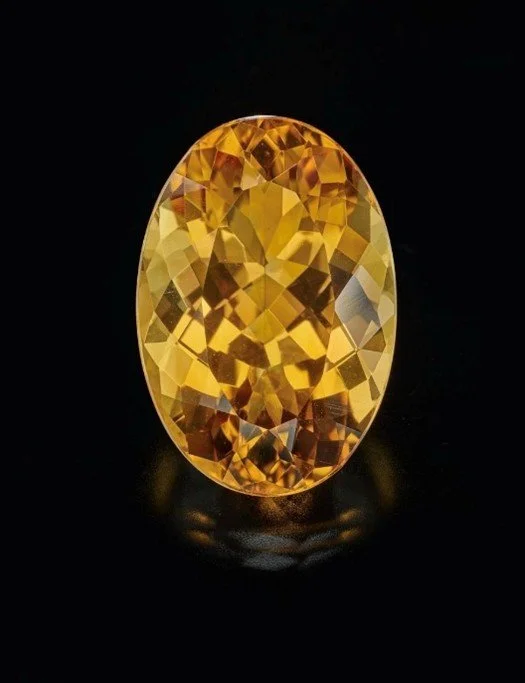
33.9ct Citrine from Brazil. Houston Museum of Natural Science auction
Despite being produced in many countries and being readily available in all jewelry stores, most citrine is not “natural”. 95%or more is actually heated amethyst. Unenhanced citrine is actually quite rare. In the mid-18th century mineralogists discovered that amethyst and smoky quartz could be heat-treated to produce lemony and golden honey hues of citrine. Because there is much more amethyst and smokey quartz available than natural citrine, this became the primary source.
The world’s most important amethyst deposits are often found in the fractures and cavities of igneous rocks which were subsequently exposed to hot, saturated fluids. Large amounts of amethyst are found in the cavities of basalt flows in Brazil and Uruguay. Large cavities can contain hundreds of pounds to several tons of amethyst crystals.
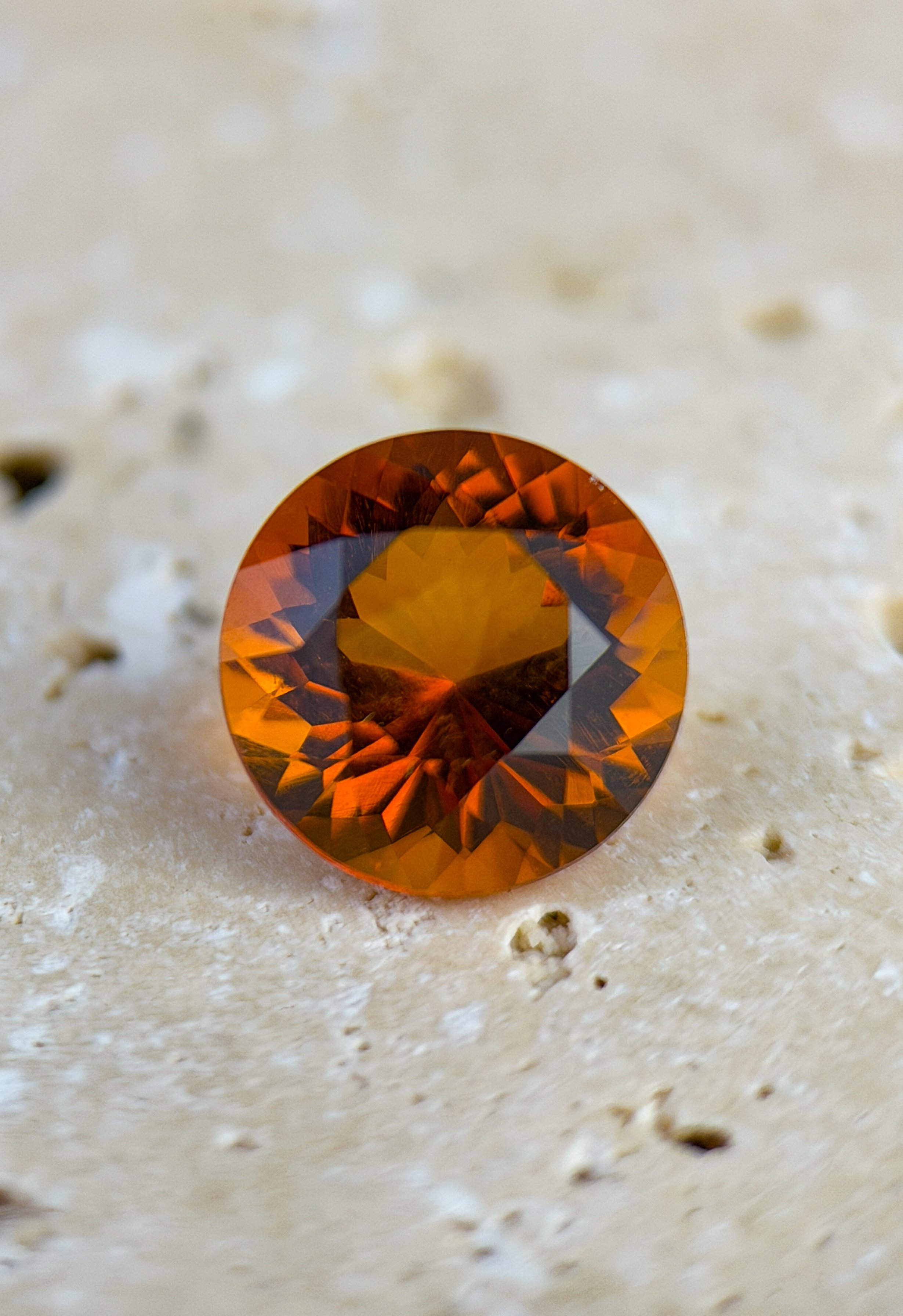
Reddish Orange Citrine, 3.81ct, Uruguay - photo & gemstone Artisan Jewelry Creations
For amethyst to form silica-enriched water at around 50-250°C makes its way into these pockets or cavities. A small amount of ferric iron (Fe³+), also in solution, will substitute for silica in the crystal lattice. The result is clear quarts with trace amounts of iron impurities. Igneous rocks like basalt often have trace amounts of radioactive minerals like radium 226, thorium 232, potassium 40, and uranium 238. Exposure to the ionizing radiation emitted by the decay of these isotopes alters the electronic state of some of the iron ions by causing an electron to be removed from the electron cloud of an Fe³⁺ ion. The ion is effectively oxidized to a higher valence state, Fe⁴⁺ and a “color center” is created. In this state, the iron-oxygen bonds in the crystal preferentially absorb green and yellow regions of light’s visible spectrum. The remaining wavelengths of light, the blue and red parts, are left to transmit through the crystal. This transmitted/reflected light is what reaches the observer's eye, resulting in the perception of the amethyst's purple color.
When amethysts are subsequently exposed to temperatures between 300-500°C (naturally or induced) the iron-based color centers destabilize, causing the purple color to fade. It is thought that upon heating the Fe4+ becomes reduced to Fe3+ and changes the nature of the Fe-O bond causing us to see a golden color instead – absorbing the red and blue wavelengths now. Depending on the temperature and duration, the crystals can turn yellow, orange, brown, reddish orange, or colorless. Higher temperatures tend to create colorless crystals. Smoky quartz produces light to medium yellows and amethyst produces stronger yellows, orange-red and orangey brown shades.
It is still debated as to whether natural citrine must go through the amethyst first pathway. Natural citrines are typically pale, but the color is better distributed than in original amethyst. It is also possible that some natural citrines derive color from aluminum trace elements rather than iron. Additional research may eventually elucidate this complex history. But it is important to remember that natural citrine is quite rare.
A Cut Above
As with all transparent gems, the 4C’s determine each gem’s quality value. Cut is the most underappreciated value factor of the four, but with citrine one can really see how it impacts the beauty of the stone! Citrine is often cut in standard gemstone shapes and sizes. Due to its relative affordability, one can often find very large size stones. More recently however, gem cutters have created unique cuts and carvings which dramatically highlight the warm colors of these gems.
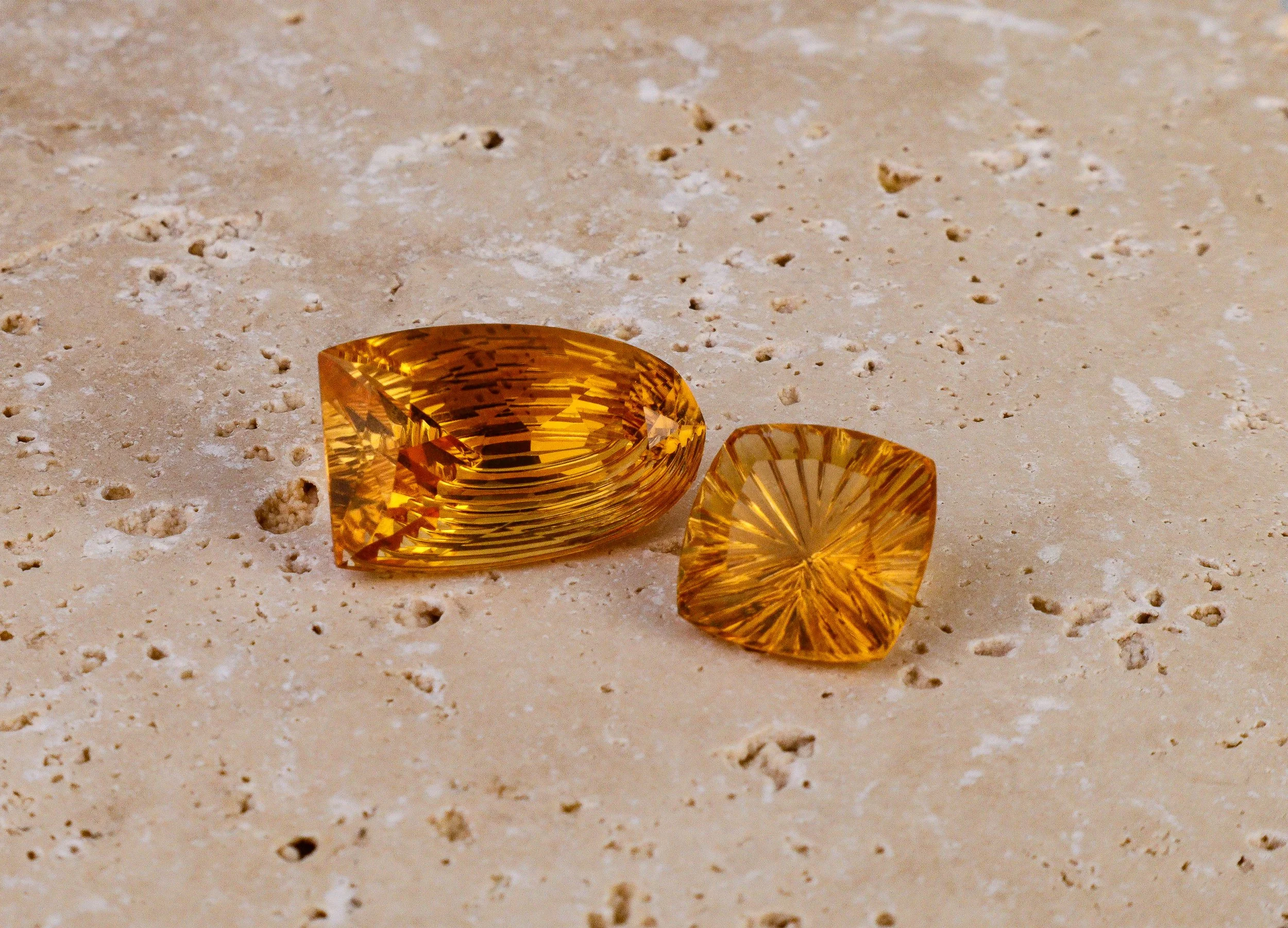
Two fancy cut/carved citrines from Brazil (26.2 and 11.7 ct respectively). Photo and gemstones, Artisan Jewelry Creations.
These fancy cuts increase the value of gems, so that these specimens are more expensive than typical quartz gems. These fancy cut stones bring a level of interest and beauty to these quartz varieties that is sometimes difficult to obtain with standard cuts. Deeply saturated stones shaped with “brilliant cuts” (higher number of facets and more precise placement) done by master gem cutters really bring the stones to life. These citrines are not humdrum gemstones anymore!
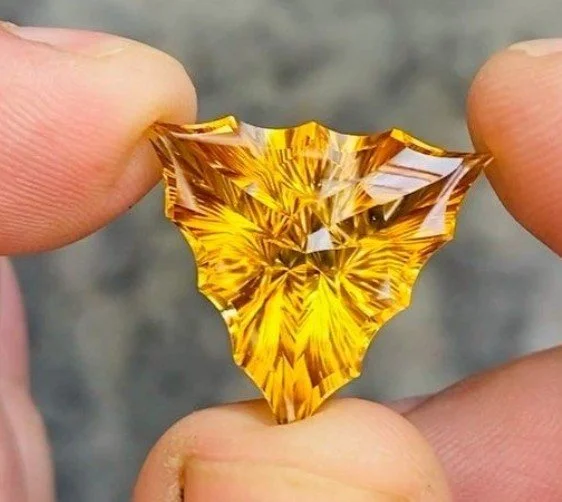
Concave Tri-Scallop Triumvirate 21ct. Photo and gemstone by RP Homer
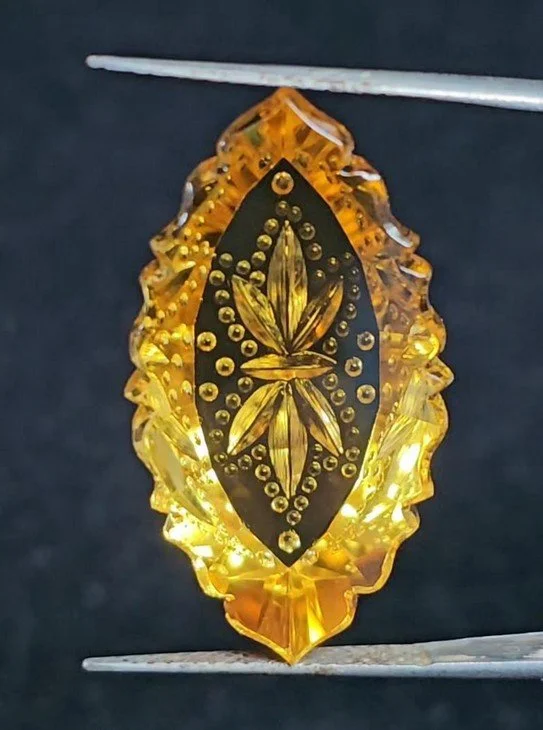
Handcarved citrine, 26ct. Photo and gemstone by GetCraftedGems
Look-a-Likes and Synthetics
Citrine is often confused with topaz due to strong similarities in color and clarity. They are both available in the yellow to orange color range and are typically eye-clean, meaning it lacks eye-visible inclusions. Some less honest dealers will sometimes sell citrine (lower cost) as topaz (higher cost).
Citrine has a Mohs hardness of 7, whereas topaz is an 8. Sometimes you can see this difference in the quality of the gemstone’s polish, with topaz taking a better polish and citrines sometimes having minute scratches. The difference in Mohs hardness does not translate into the same difference in durability. Topaz has perfect cleavage in one direction, which can make it much more prone to breaking. Citrine does not have this issue. It is usually durable enough for use in jewelry for normal wear. It can be easily and safely cleaned with warm, soapy water, no need for an ultrasonic cleaner!
Lab-created citrines do exist, dominantly produced in Russia. It is extremely difficult to tell the difference between natural, heat treated, and synthetic citrine. Lab-created corundum in a yellow to orange color is sometimes used as a citrine simulant in birthstone jewelry because it is even less expensive than citrine.
Style & Fashion
Citrine has a bright, warm color that fits perfectly with other earth tones (browns, greens). It also offers a striking contrast paired against black, gray, blue. It even shines when paired with white or ivory. Style-wise, citrine is an incredibly versatile stone. It’s great as citrine but can be used as a cost-effective alternative for topaz, yellow diamond, and yellow sapphire. Reddish citrines in particular can substitute for many red gemstones for a more affordable alternative. It’s a great talking piece too because so few people expect the stone to be citrine!
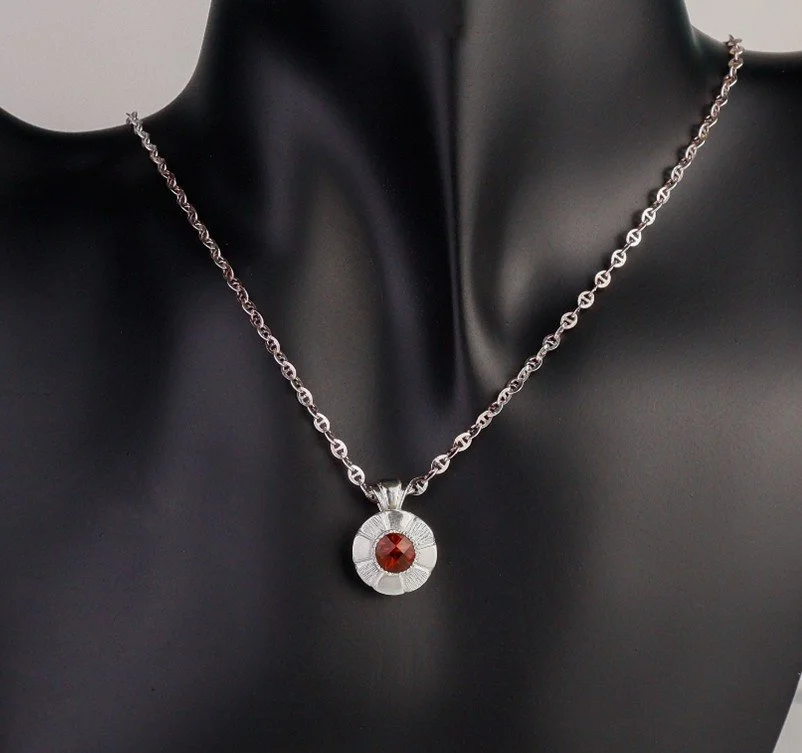
Reddish orange Citrine (Brazil), Argentium silver (94%) pendant, and sterling silver chain (18 inch). By Artisan Jewelry Creations.
REFERENCES
Merriam-Webster.com Dictionary, Merriam-Webster, https://www.merriam-webster.com/dictionary/citrine.
https://store.museumofjewelry.com/blogs/news/the-money-stone-a-history-of-citrine-jewelry
https://myarmoury.com/feature_spot_dirks.php
N Monarumit et al 2021, J. Phys.: Conf. Ser. 1719 012001 Causes of color in purple- and yellow- quartz (https://iopscience.iop.org/article/10.1088/1742-6596/1719/1/012001/pdf)
Chen, R., et al, 2022, The color mechanism of iron on quartz by ion implantation, Physica B: Condensed Matter, Volume 627, 413550, ISSN 0921-4526,
Chen, R., Liu, Y., Lin, J. et al. Study on the color mechanism of amethyst after heat treatment and first-principle calculation. Appl. Phys. A128, 914 (2022). https://doi.org/10.1007/s00339-022-06068-w (https://doi.org/10.1016/j.physb.2021.413550)
This article is written without the aid of AI.