I’m thinking of a special gemstone…..
Its color is often strongly saturated. Many are free of inclusions, but the ones that do have them show amazingly interesting ones! It’s been used in jewelry for thousands of years and in some cases only royalty was allowed to have them. You can find it in every color of the rainbow, and even with color change phenomena. Some even have greater fire than diamonds.
Was “Garnet” your first thought? No? It should have been!
January’s birthstone is, understandably, often dismissed as incredibly boring. Jewelry stores have rows of dark, inky red, no sparkle, no beauty garnet jewelry. The truth is that although these are garnets, those examples don’t approach the beauty and allure that garnets are capable of! It’s a huge shame if those are the only garnets you’ve seen. Hopefully, we’ll fix that very soon!
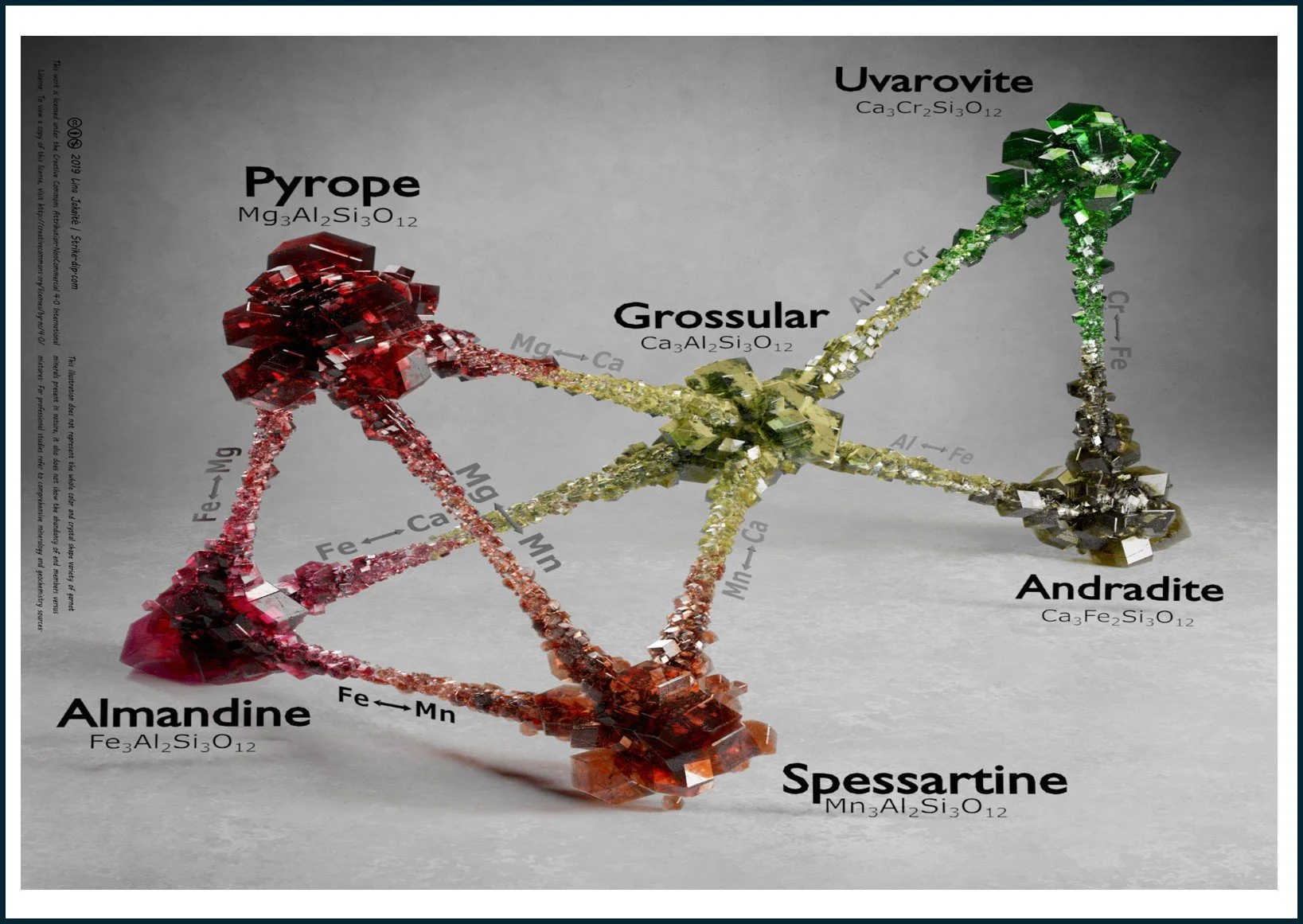
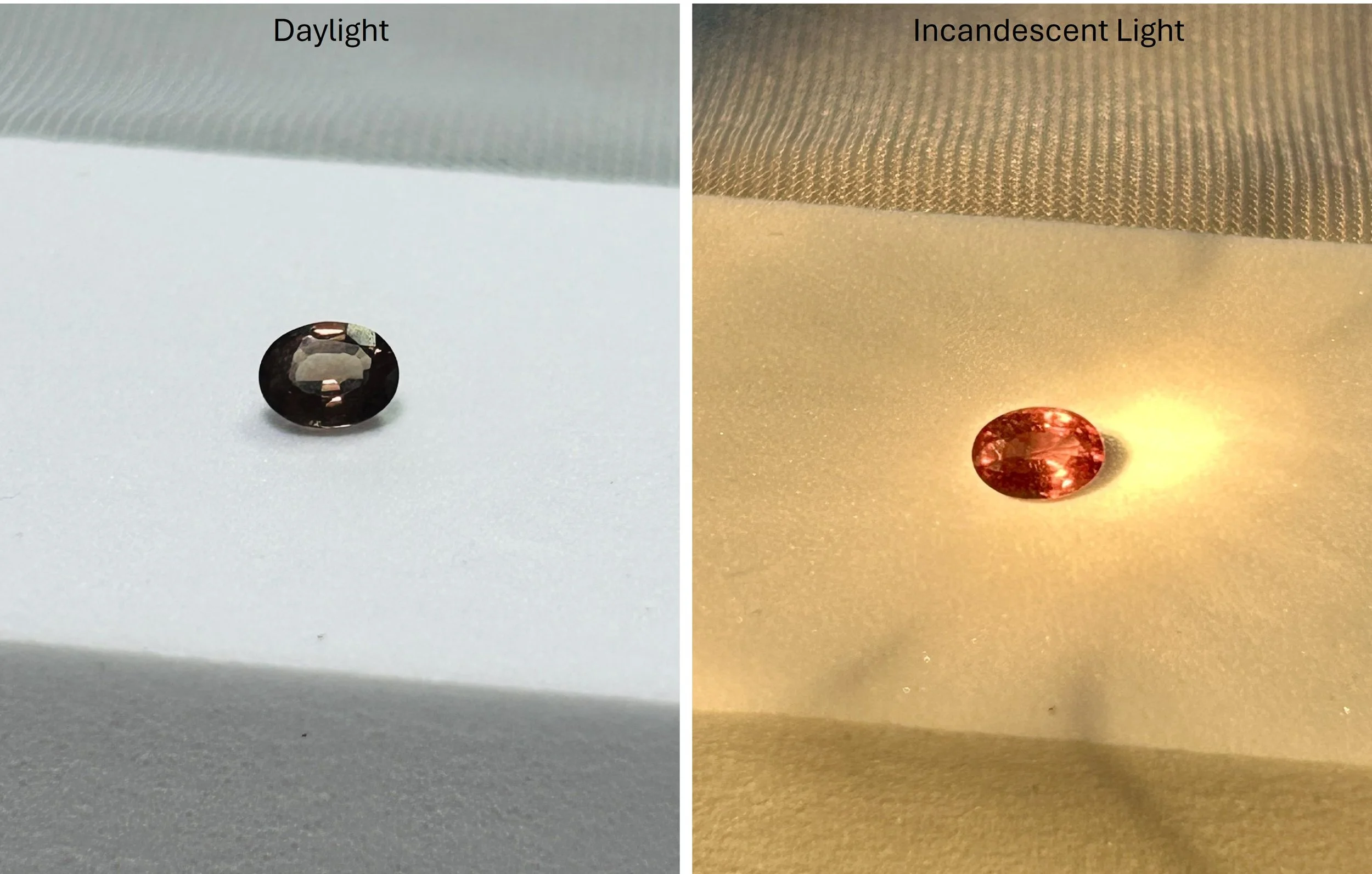
Rather than a single mineral, Garnet is a group of closely related mineral species. In mineralogy, a “group” is made of members with either crystal structure or chemical composition in common, but not both. All garnets have the same crystal structure, creating a rhombic dodecahedron form, but each species varies slightly in chemical composition. The result is an impressive range of colors and properties across the group. Garnets can be green, yellow, orange, pinkish orange, red, purplish reds, purple, colorless, or blue. Some also display a rare color-change phenomena where the color of the gem changes depending on the color temperature of the ambient light (daylight vs candlelight).
The chemistry of garnet is expressed as X3Y2(SiO4)3. In this recipe, X can be calcium, magnesium, iron, or manganese, and Y can be aluminum, iron, manganese, vanadium, or chromium. This chemical agility results in >20 garnet species, 5 of which are considered gemstones: pyrope, almandine, spessartine, grossular, and andradite. But even that is misleading, as many garnets are mixtures rather than one of the chemical endpoints, resulting in a group that is incredibly diverse.
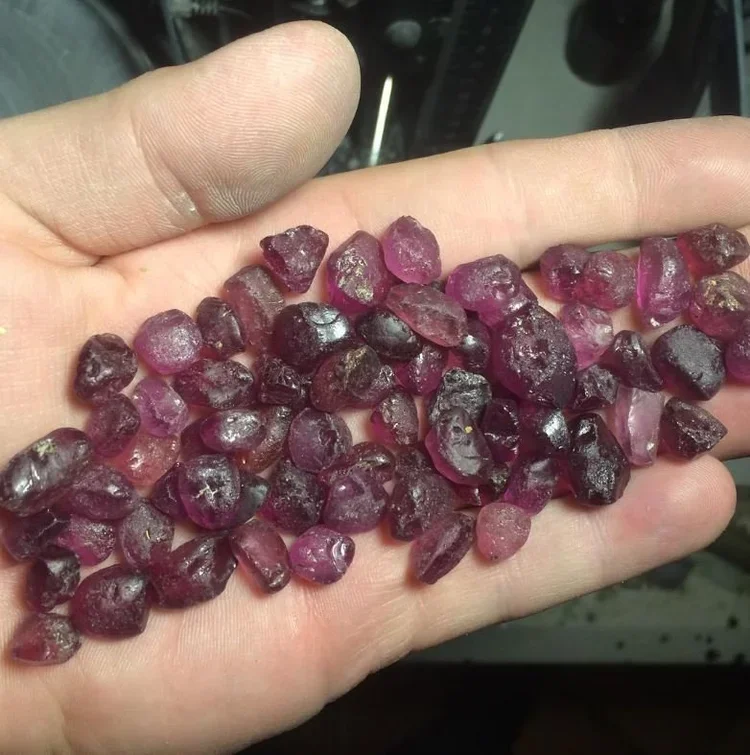
If you live in the Greater Houston area (or travel here), you now have an opportunity to see this diversity in person. An extraordinary necklace showing the incredible range of garnets is currently on display at the Houston Museum of Natural Science. Garantus, as it’s named, showcases the breadth of colors and optical characteristics of the garnet group, as well as the specialized faceting knowledge required to bring those to life, all in a stunning design and engineering masterpiece.
The 29-inch long necklace is made of 77 carats of garnet and 3 troy pounds of platinum. It is the result of a multi-year collaboration between the award-winning team of gem faceter (and garnet afficionado) Todd Wacks and jewelry designer Mary van der Aa. The piece features a multitude of different cuts (round, princess, oval, emerald, and more) executed by Wacks who began collecting garnet rough over a decade ago. Wacks acquired the first stone, a 2.75 ct blue color-change garnet from Bekily, Madagascar. His collecting focused on high clarity, color, and dispersion as well as exceptional type examples. The entire collection took 15 yrs to assemble. Based on analysis done by researchers at the Gemological Institute of America (GIA), the garnets demonstrate the entire range of garnet chemistry in the natural world.
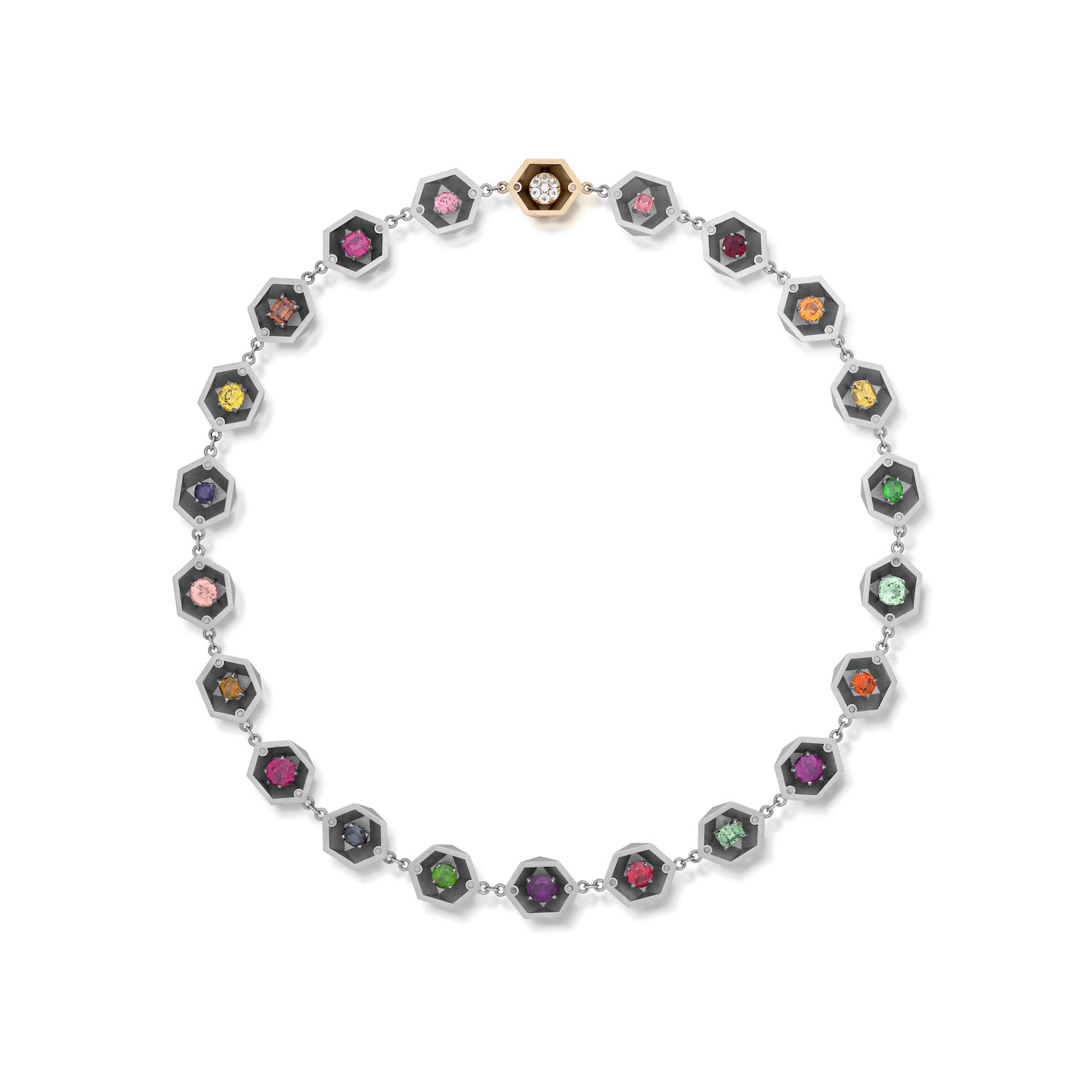
Garantus showcases the breadth of garnet characteristics in color, fire, brilliance, and special phenomena. “Garnet” comes from the Latin word “Granatus,” meaning “seedlike.” This nomenclature hints at the gem's resemblance to pomegranate seeds. “GARANATUS” is a play on this Latin word.
Photo courtesy of Mary van der Aa.
Gem faceters are like sculptors, taking a rugged or erosion worn rough crystal, and through a balance of science, artistry, and expertise, they bring a gemstone to life. The flashes of color, sparkle, and brilliance you see in a finished gem are a testament to the knowledge and vision of the faceter. Not all are able to bring forth deep color and high dispersion in stones that are not usually known for that, but Wacks has proven a talent for this. (Dispersion is an optical property where white light is split into its spectral colors within the gemstone. It is referred to as “fire” in gemology)
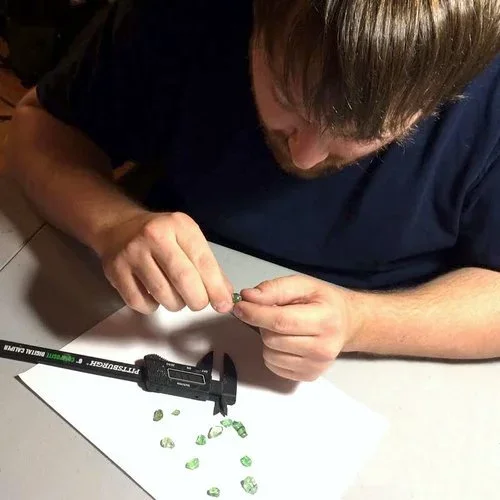
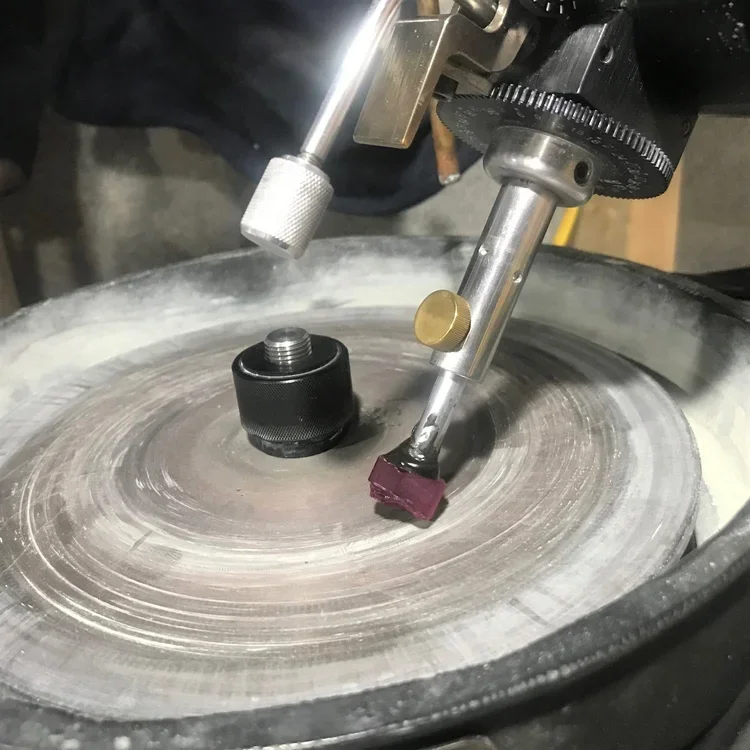
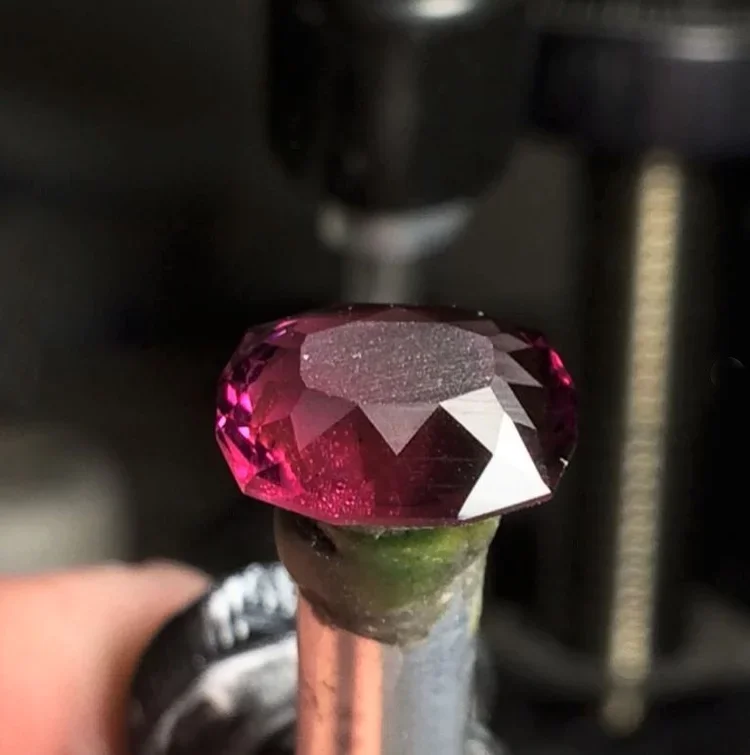
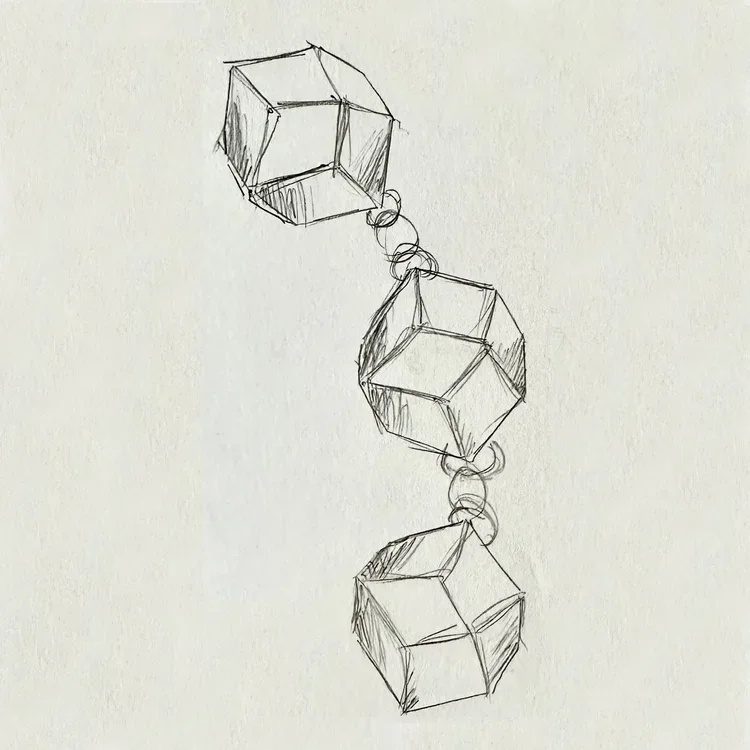
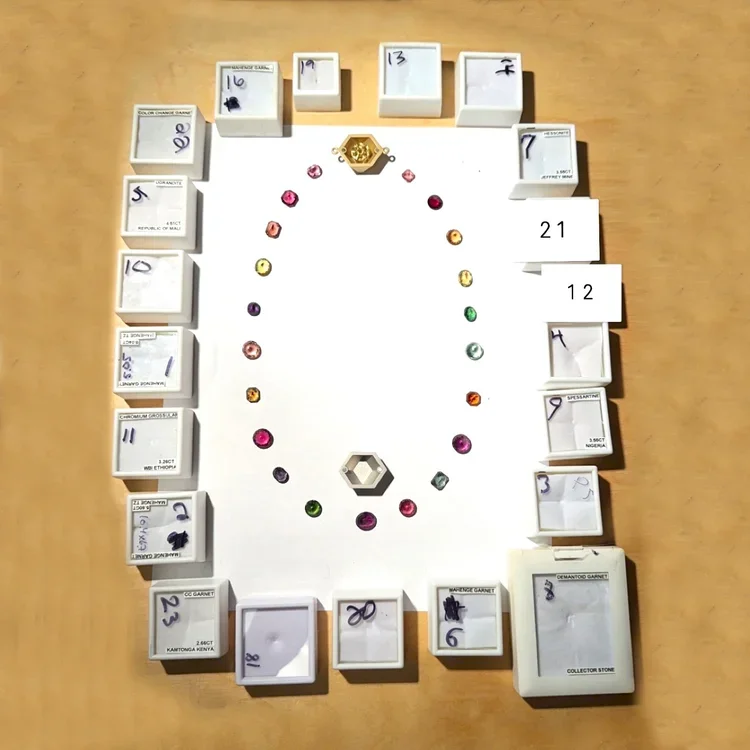
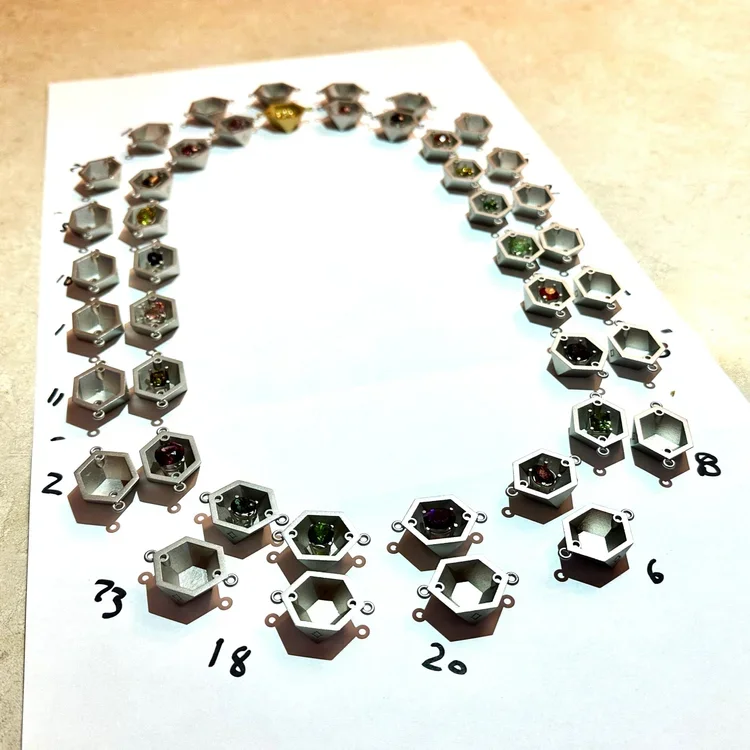
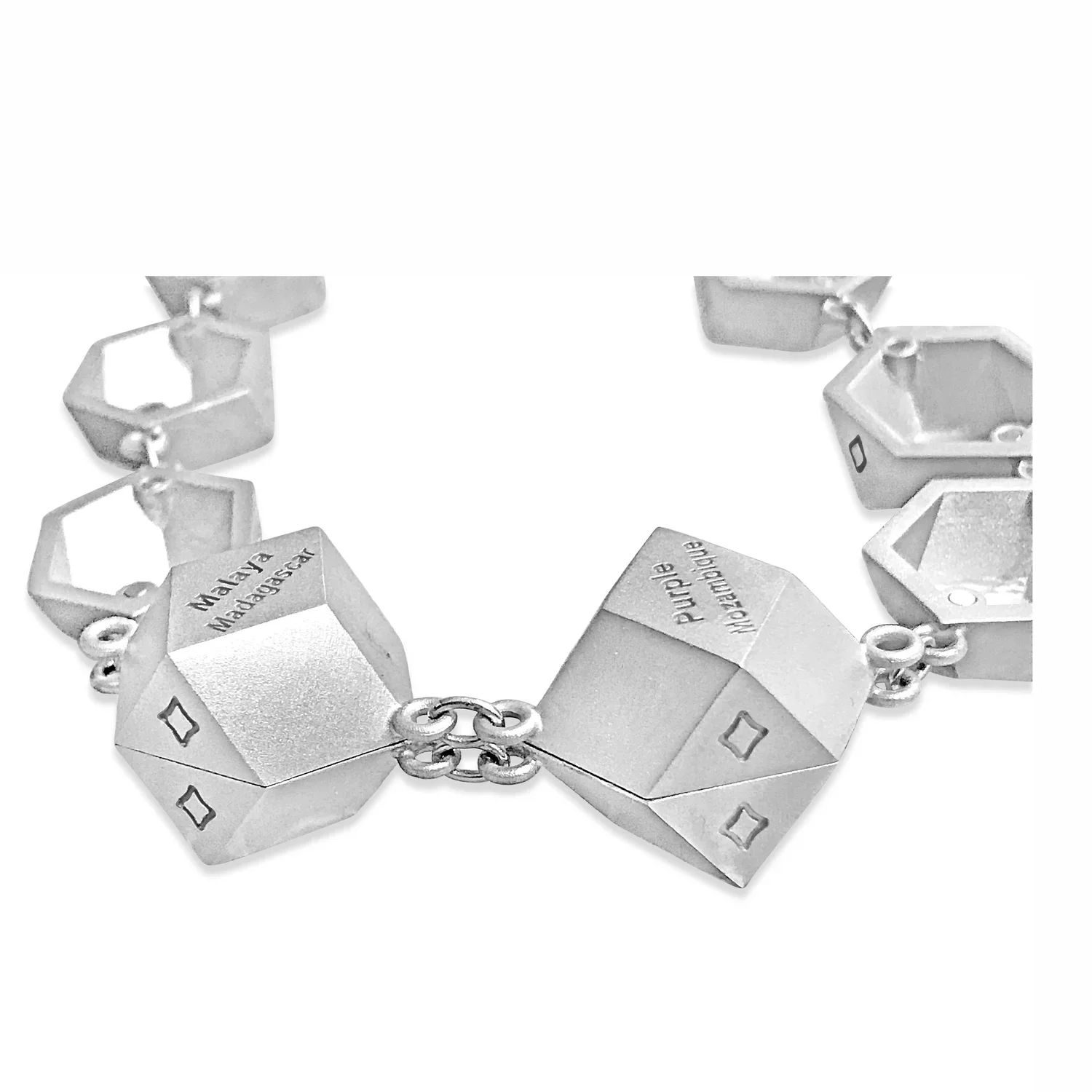
With the idea of showing the mine to market journey of this incredible collection, the pair decided to team up to set Wacks’ gems into a van der Aa design. It took the designer three years to design, engineer, and craft this unique necklace. The necklace is composed of two pieces. The base portion contains a series of links, each individually set with a unique variety, location, and color of Garnet. On the back of each link is engraved not only the type of garnet, but also the mine locality. The top portion demonstrates the ingenuity, and challenge of the design - a top jacket that attaches to the base portion with tiny neodymium magnets to create the shape of natural garnet crystals. When combined, each link becomes a rhombic dodecahedron, a natural crystal habit found in the isometric (cubic) crystal system, for which garnets are known.
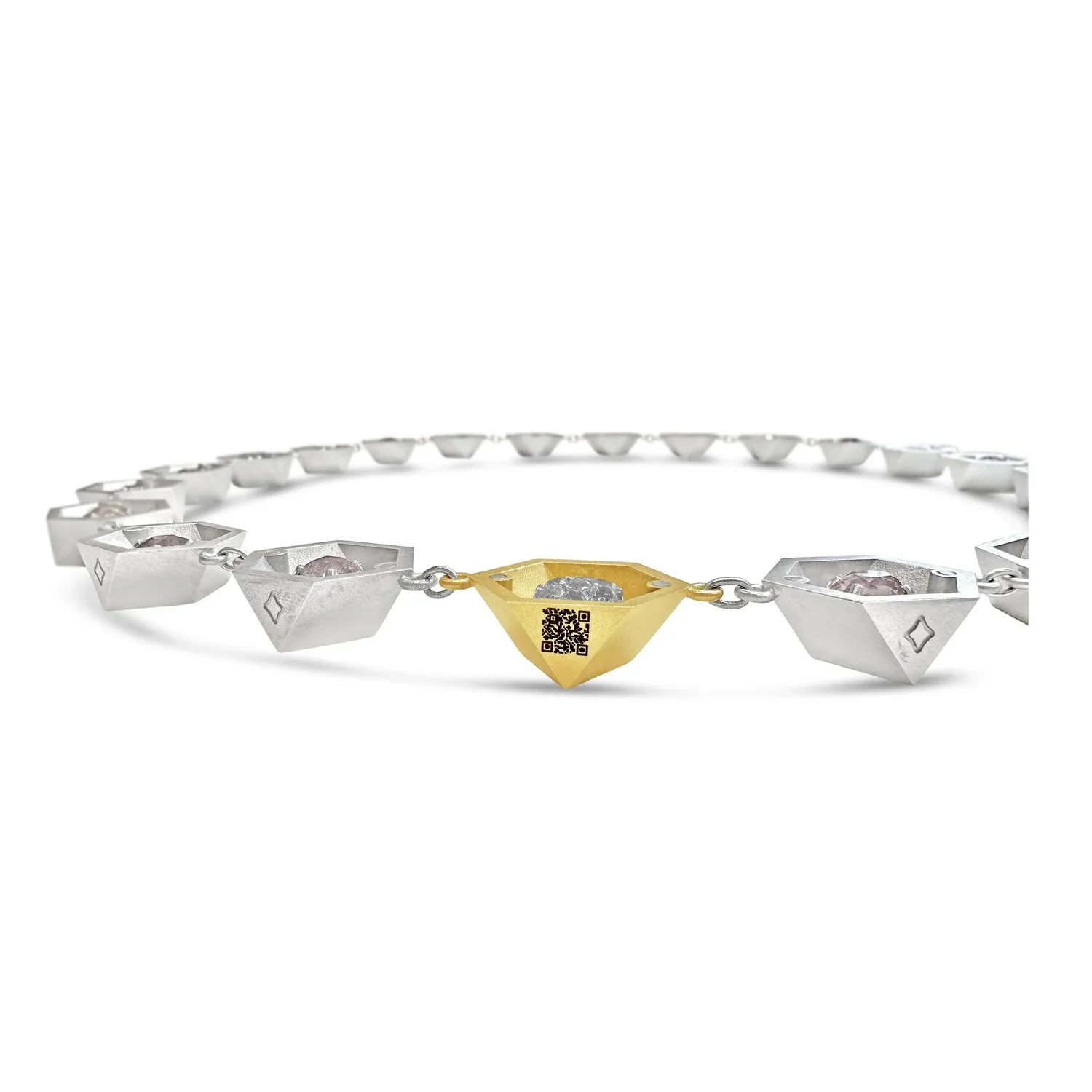
The majority of the necklace is crafted in platinum. One link, however, is made in 18k yellow gold. This link holds a laser-engraved QR code (which would not be visible in platinum). The QR code leads the viewer to a dedicated website where they can delve deeper into the origins, characteristics, and significance of this remarkable necklace.
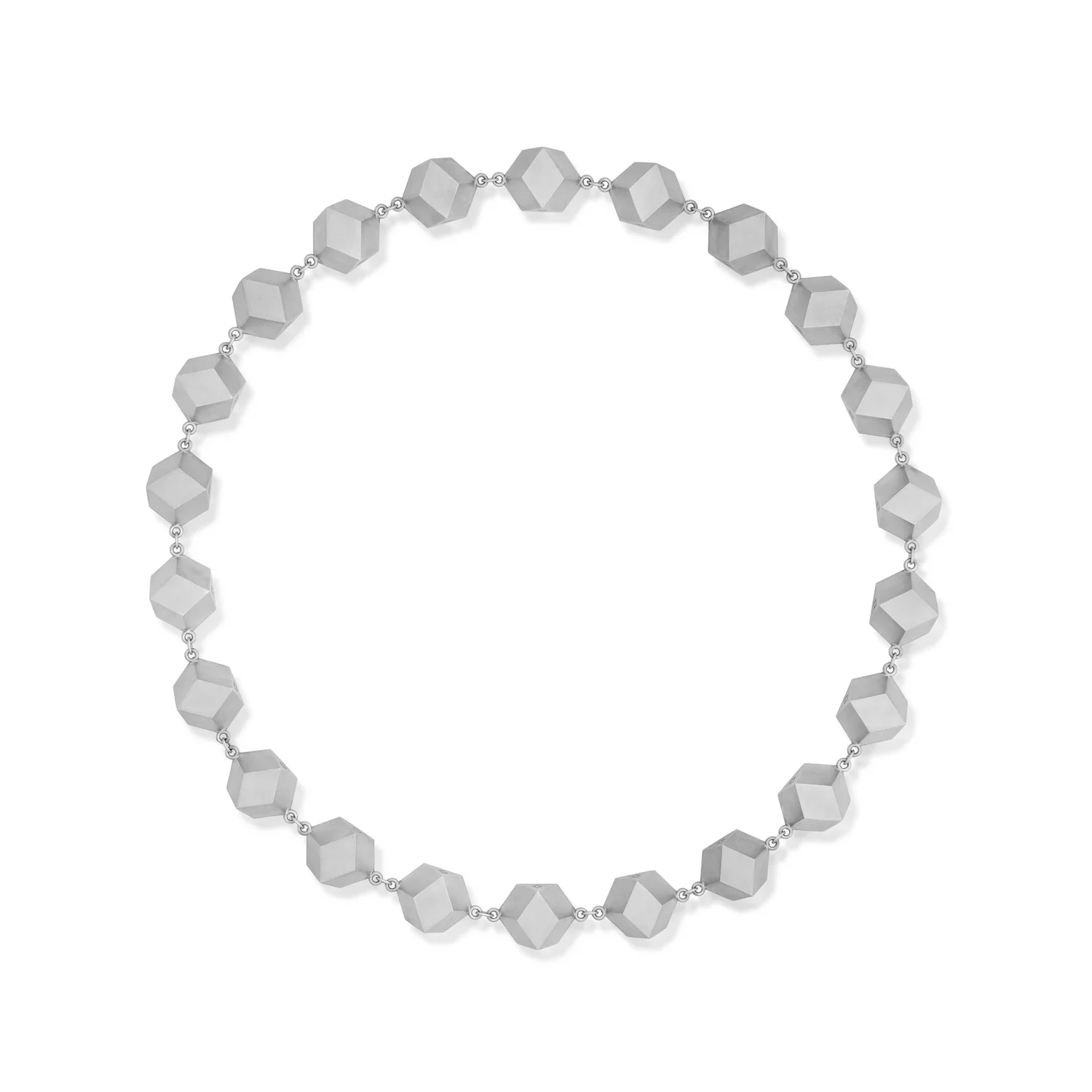
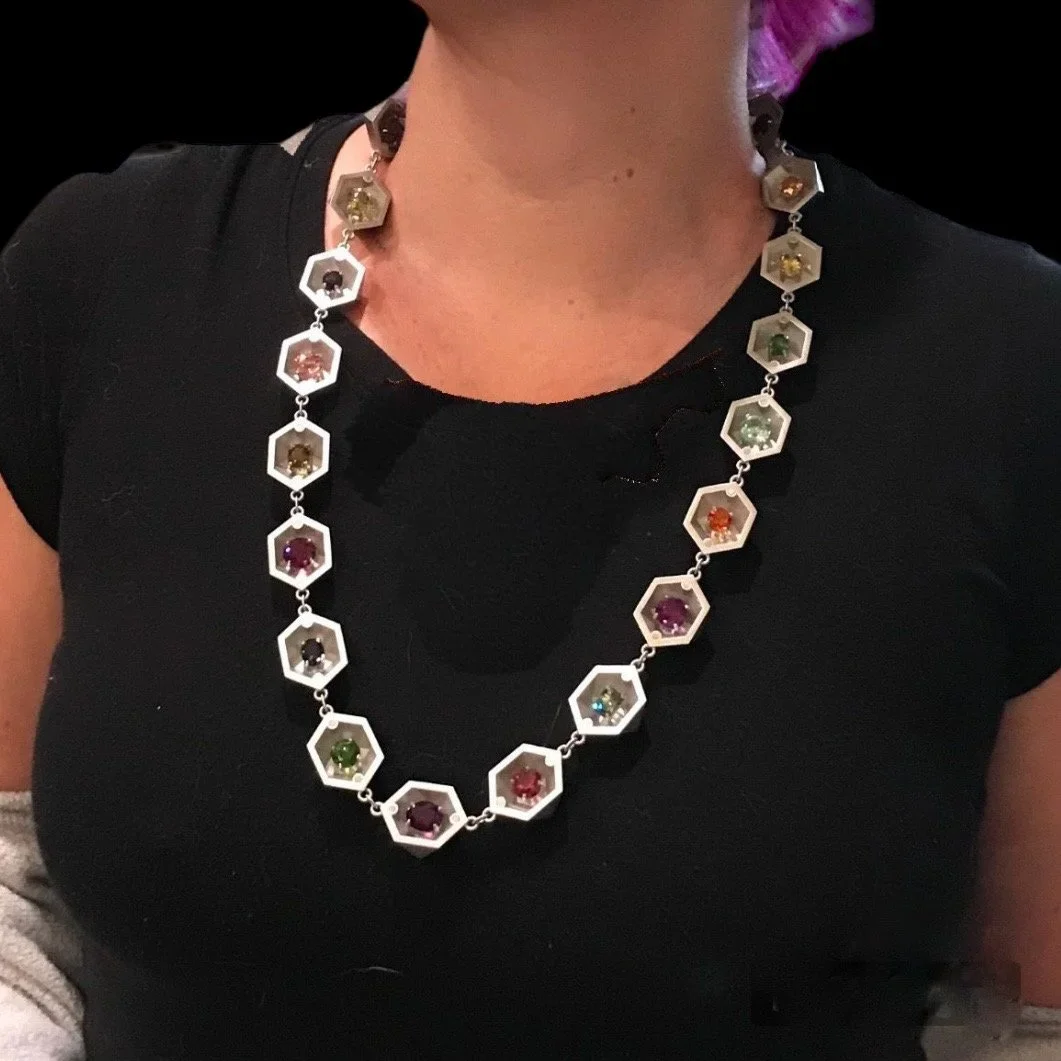
In 2023 Garanatus won two AGTA Spectrum Awards. In 2024 it was spotlighted in the journal Gems & Gemology and featured on both the front & back cover. It was displayed at both the GIA Museum at their Carlsbad Headquarters (California) and at the Alfie Norville Gem & Mineral Museum in Tucson, Arizona. It has been described as “likely the most impressive necklace in history displaying the beauty of the garnet group.”
Today, it’s being displayed at the Houston Museum of Natural Science. Although the Cullen Gem & Mineral Hall is undergoing a multi-year renovation and is closed to the public, a few select gem specimens and jewelry pieces have been put on special display in the Hamill Gallery on the first floor. These are extraordinary gem examples and historic pieces of jewelry. PRO TIP: As this is considered part of the museum’s permanent exhibitions, you can tour those for free on Tuesdays from 5:00-8:00pm.
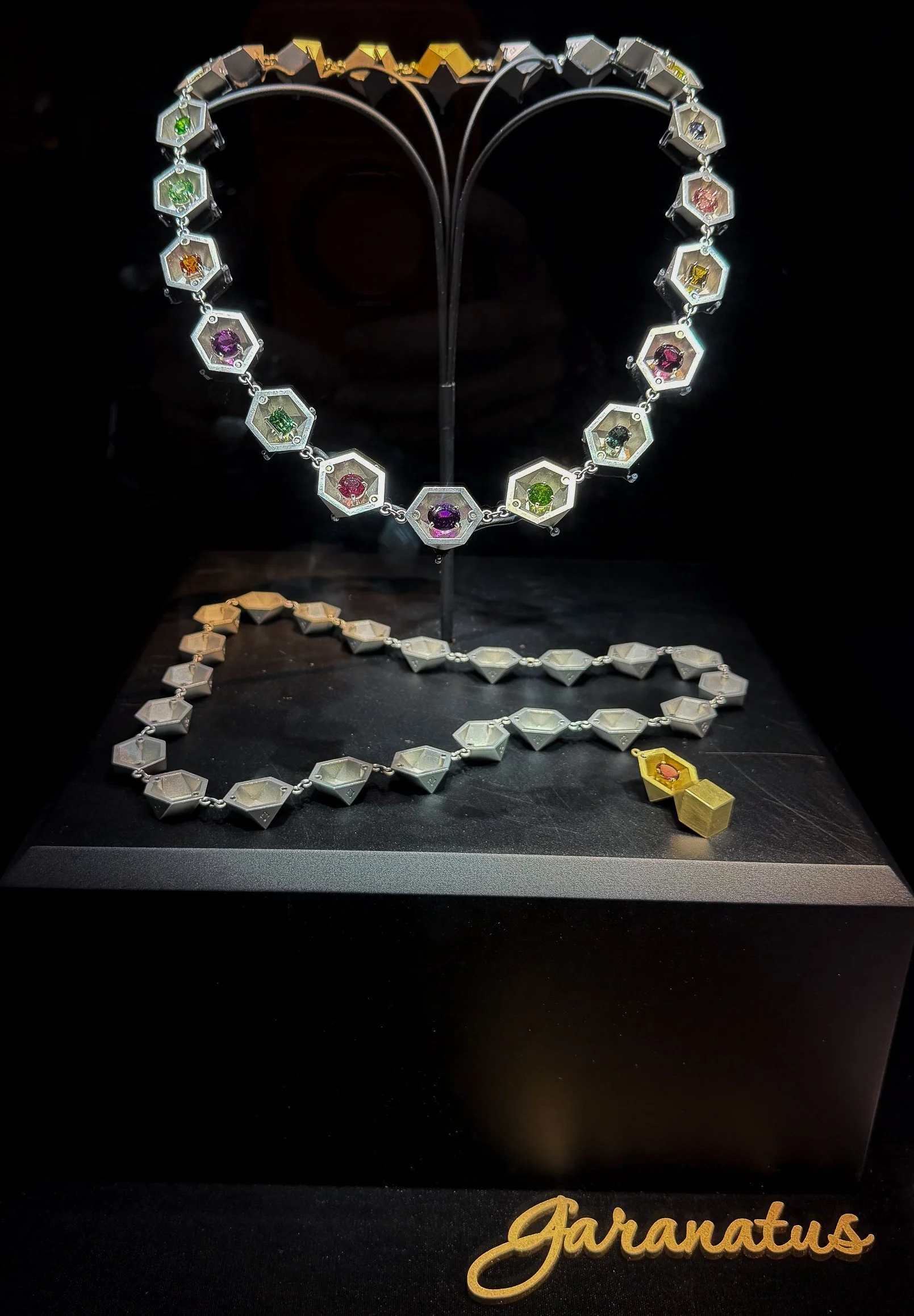
Garanatus on display at HMNS Hamill Hall. Both top and base portions of the necklace are visible, as is one of the brass prototypes constructed during the design and engineering phase (base right).
Unfortunately, in HMNS’ display you cannot see the engraved sections nor the QR code.
Photo author’s own.
After viewing this extraordinary piece, put an additional note on your calendar. From Nov 13-15, Todd Wacks and Mary van der Aa will be at the Annual Gem, Mineral, Jewelry & Fossil Show put on by the Houston Gem & Mineral Society at the Humble Convention Center. You can see a large selection of gemstones cut by Todd (not just garnets) as well as a selection of Mary’s award-winning jewelry (6-time award winner). I highly recommend a visit! Many of the best gemstones I have (and use in my jewelry) are cut by Todd – he is a master! They are also great people to talk to and get answers from about gemstones and jewelry (look for the Tucson Todd booth). And if you’re lucky, you’ll also be able to meet Dutchie – an absolutely adorable rescue pup!
Garantus specifics:
The 28 garnets range in size from under a carat to 5.63ct. Five of them show color change phenomena (not visible in the museum display). All gems are natural, with no treatments and were faceted by Tucson Todd’s Gems.
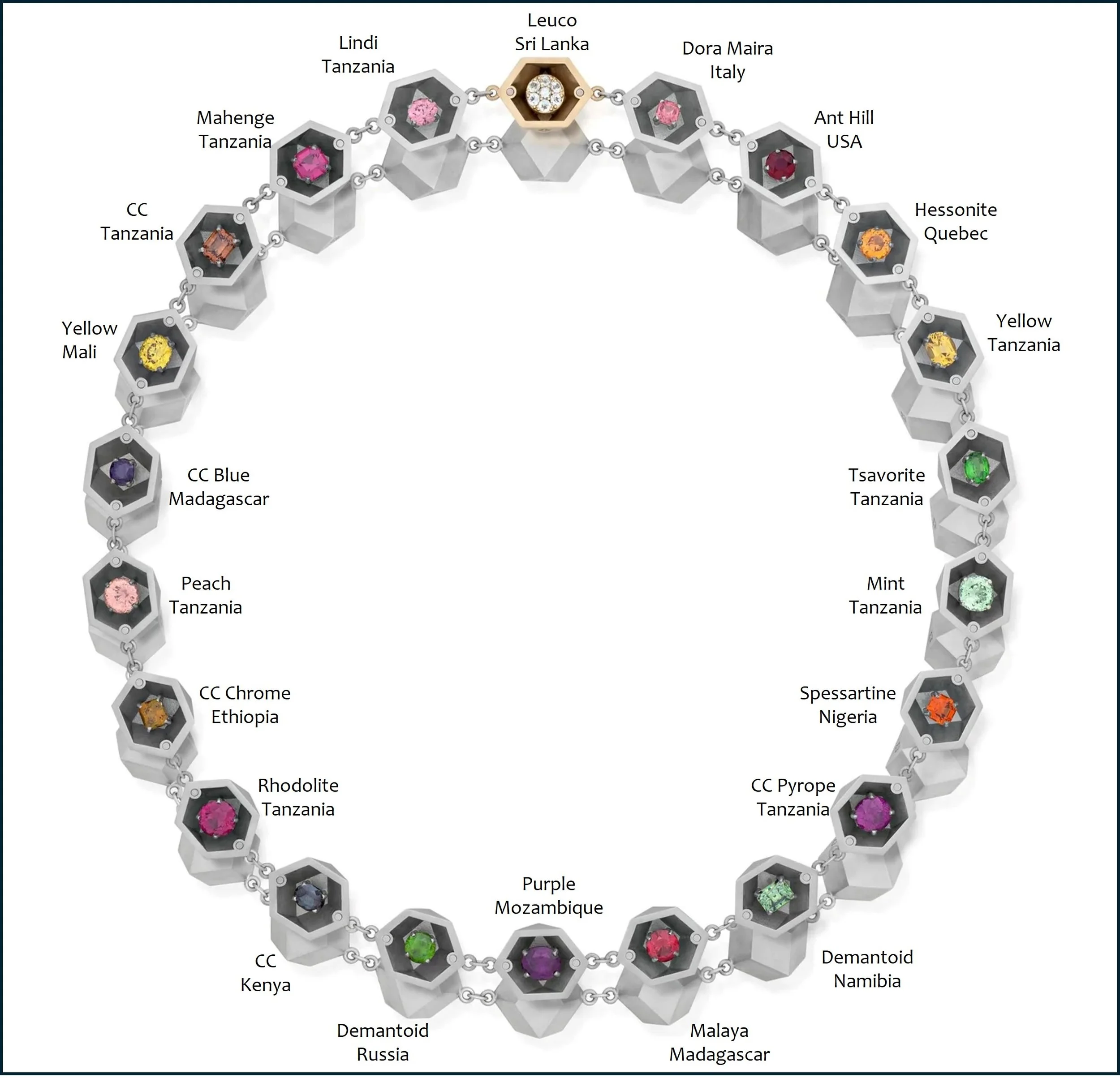
Garanatus garnets and countries. Specifics on each garnet are found below.
Leuco Garnet, 1.40cttw, Sri Lanka - Modified Round Brilliant
Leuco garnet is a trade name for a colorless or “white” garnet. These are usually classified as grossular garnets (Ca3Al2(SiO4)3. To be colorless, the environment within which these form had to be free of any trace impurities or transition metals (iron, chromium, vanadium, or manganese). This is a very rare occurrence in nature, and only a few deposits of colorless garnets have been discovered. Crystals are typically small and finding one over 1ct is extremely rare.
Dora Maira Garnet, 1.69ct, Piedmont, Italy - Asscher cut
Dora Maira Massif, located in Northwestern Italy, is one of the internal crystalline massifs of the Western European Alps. The first location on Earth where ultra high-pressure (UHP) metamorphic rocks were described and recognized as forming a coherent unit (peak metamorphic pressures exceeded 3 GPa (i.e. = 100 km depth) at temperatures near 700-750°C). Although others have since been found, the Dora Maira remains unique for the composition of near near-end member pyrope garnet (88%-98% pure) found in a metasomatic whiteschist assemblage occurring as lenses within metagranite.
Near pure pyrope garnets are rare, and sizable gem quality crystals from Dora Maira are extremely rare. Most people have never seen sizable material cut into gems. The one in this necklace at 1.69ct is one of the world’s largest examples of this exceptional type of garnet.
Ant Hill Garnet, 2.47ct, Arizona - Modified Round Brilliant
“Ant hill” garnets are an iron-bearing pyrope garnet with distinct amounts of chromium. The deep red color is mainly caused by the chromium component. The name derives from its unique source locality, the arid desert Navajo Nation in Arizona. Desert harvester ants excavate deep tunnels there while building their nests. As they encounter the garnet crystals the ants push them out of the nests, to the ant mound on top. Local Navajo collectors have been gathering them from these hills for generations.
Anthill garnets are usually small and after cutting rarely exceed 1 ct in size. An example of this size is exceedingly rare.
Hessonite Garnet, 3.55ct, Jeffrey Mine, Quebec - Modified Round Brilliant
The Jeffrey Mine was, for much of the 20th century) the largest asbestos mine in the world but became internationally famous for also producing exceptional calcium rich mineral specimens, including hessonite. The mine was located in a serpentinized ophiolitic complex where the focus was extraction of chrysotile. During serpentization of the original rocks the asbestos minerals are created. At the same time, hot, calcium-enrich fluids are expelled and those alter adjacent mafic dykes. This complex process creates rodingite assemblages in the form of dykes, lenses or boudins within the serpentinized body. The spectacular collector minerals are found here.
Hessonite is an orange to reddish brown variety of grossular garnet [Ca₃Al₂(SiO₄)₃]. The Jeffrey Mine produced some of the finest hessonite garnet specimens in existence. You do not however see many faceted stones. This one is not only gem quality, it is also exceptionally clean without the “scotch in water” effect seen in most Hessonites.
Yellow Garnet, 3.00ct, Lemshuku, Tanzania - Modified Oval Brilliant
The Lemshuku area is well known for grossular garnet deposits, but the best known are green not yellow. This is part of the Neoproterozoic Mozambique Belt, which stretches from the Arabian-Nubian shield to Madagascar, and also includes the Merelani Hills mining area, famous for tsavorite. The tightly folded Neoproterozoic metasedimentary sequence was created during the East African Orogeny (700–500 million yrs ago) the primary collision zone which formed Gondwana.
In the 1980’s, an extremely small and exclusive deposit of yellow grossular garnets was found. This deposit produced clean, bright yellow garnets, unique because the yellow color is primarily due to manganese (Mn²⁺), distinctly different than their green cousins.
Tsavorite Garnet, 2.08ct, Merelani, Tanzania - Modified Oval Brilliant
In 1967, British geologist Campbell Bridges first discovered these grossular garnets in Tanzania but later found a substantial deposit near Tsavo National Park in Kenya. The geology here is part of Mozambique Belt discussed above (yellow garnet). The rocks are intensely folded and metamorphosed sedimentary sequences. Tsavorite was a unique find because no other garnet had been identified exhibiting this vivid shade of green. It is still distinct to tsavorite. The color is the result of trace amounts of vanadium and chromium, the same elements that give emerald its color.
Mint Garnet, 5.03ct, Merelani, Tanzania - Modified Round Brilliant
Mint Garnet is a pastel green grossular garnet. Like tsavorite, it too is colored mostly by vanadium but its color saturation is much less. These garnets were discovered in pockets within the tanzanite mines in the Merelani region of Tanzania, also within the previously described East African Mozambique Belt. Crystals are typically small and gemstones over 2ct in weight are quite rare.
Spessartine Garnet, 3.56ct, Nigeria - Dutch Asscher
Spessartine garnet [Mn₃²⁺ Al₂(SiO₄)₃ ] is one of the rarer and lesser-known varieties of garnet, named for the Spessart district in Bavaria, Germany, where it was originally discovered. The color can range from orange to reddish-brown depending on how it’s blended with other garnet species. Those closer to pure spessartine have orange colors, while those trending towards reddish hues have increasing almandine content. “Mandarine” garnets (vivid orange) have the highest percentage of spessartine (85%-95%). These garnets have a remarkably good at high refracting light, resulting in exceptional brilliance.
Color-Change Pyrope Garnet, 5.62ct, Morogoro, Tanzania - Modified Round Brilliant
A new garnet gemstone made its debut in late 2014 when vibrant, color-change pyrope garnets, that had been found by miners in Morogoro, Tanzania in 1987 finally came to market. There was only one pocket of them found and it took years to discover their amazing characteristics. Tucson Todds Gems was instrumental in getting these analyzed by GIA researchers. These pyrope garnets change from a rich purple in daylight to a hot pink in incandescent light. Their scarcity and uniqueness make them sought after and highly collectible.
Demantoid Garnet, 3.33ct, Green Dragon Mine, Namibia - Modified Emerald
Demantoid garnet is one the rarest of all colored gemstones, and the most valuable of the garnets. It is a variety of andradite [Ca3Fe2(SiO4)3]. Its famous vivid green color is caused by chromium, with ferric iron imparting a yellowish tone to the green. First discovered in an alluvial deposit in the Russian Ural Mountains in 1851. Andradite garnets have very visibly high luster, high light refraction, and exceptional dispersion (fire) so the comparison to diamonds is understandable, thus the name “demantoid”.
Namibian demantoid was discovered in 1996. The garnets occur in irregular pockets within the Neoproterozoic to Paleozoic metasedimentary sequence of the Damara Orogeny (Gondwana assembly) that had been later intruded by the Cretaceous granitic Erongo Complex. Most of the production is in small sizes, with fine singles being extremely rare, and faceted gems over 2 carats are considered exceptionally rare. The demantoids from Namibia are very clean, with few inclusions.
Malaya Garnet, 4.03ct, Madagascar - Modified Round Brilliant
Malaya (or Malaia) garnets typically have colors in the pink, pinkish orange, reddish orange, to yellowish orange ranges. Discovered in the 1960s in the Umba Valley in Tanzania, these pink gems were called malaia, Swahili for "out of the family." Miners searching for violet rhodolite set aside these stones as they didn't fit into any known garnet varieties. Over time, the outcasts became highly prized. The Madagascar deposits were discovered in the late 1990’s within the East African Mozambique Belt.
Malaya garnets from Madagascar have bright, saturated colors, and high clarity. They are a hybrid garnet [(Mg,Mn,Fe)3Al2(SiO4)3] with a mixed chemical composition primarily consisting of pyrope and spessartine, with variable amounts of almandine. Minor or trace amounts of grossular and andradite are also possible. Their colors are based on the amount of iron and manganese within the crystal.
Purple Garnet, 5.15ct, Mozambique - Modified Oval Brilliant
Purple garnet from Manica Province in Mozambique produced to date the finest pure purple garnets in existence. The chemistry of these garnets fits within the series pyrope (Mg3Al2Si3O12) – almandine (Fe3Al2Si3O12), which makes them a rhodolite garnet with a very unusual color. As with many garnet varieties the color is caused by iron and manganese, but in this case, the two elements appear to be absorbing the full yellow to green portion of the visible spectrum, leaving only blue and red visible, which we see as purple.
These garnets are normally not found in sizes over 3ct. In addition, the area is under the control of armed rebels, so that additional material is extremely hard to come by.
Demantoid Garnet, with Horsetail, 3.05ct, Russia - Modified Round Brilliant
Demantoid garnets were first discovered in an alluvial deposit in the Russian Ural Mountains in 1851. The chromium-green variety of andradite became a favorite of the czar’s court jewelers, including Carl Fabergé. Demantoid fever infected all of Europe by the end of the 19th century. After the Bolshevik Revolution, gem production was halted and demantoids disappeared until revived in the 1980’s.
Russian demantoids are formed in serpentinized ultramafic rocks (peridotites & ophiolites). This is also where chrysotile asbestos forms, which explains the Russian demantoid’s most famous characteristic – horsetail inclusions. Although demantoids from Italy and Iran also have horsetail inclusions, those deposits do not create crystals large enough to facet. Demantoids from other regions do not display these inclusions, so they are commonly used as proof of Russian origin.
Most Russian demantoids are less than 1ct, and those over 2ct are considered rare. These garnets are not only sought after for their beauty and rarity, but also because of their history.
Color-Change Garnet, 2.66ct, Kamtonga, Kenya - Modified Oval Brilliant
The Taita-Taveta area of Kenya is known for its tsavorite production, along with other gems. In 2009 however, a new gemstone was found which changed from blue-green in in daylight to purplish-red in incandescent light (color-change). At first, locals mistook it for alexandrite. We now know these are garnets that fall in the pyrope-spessartine series with varying amounts of almandine. The color is caused primarily by vanadium and manganese.
The stones were found in an alluvial deposit, which was essentially mined out within a year. Only about 5% of the production exhibits a true, strong color change. However, this production is of an astonishingly high quality – transparent with excellent, dramatic color change. The primary deposit has yet to be discovered. These garnets are a true rarity.
Rhodolite Garnet, 5.63ct, Mahenge, Tanzania - Modified Round Brilliant
Rhodolite garnets fall within the pyrope– almandine (Mg3Al2Si3O12 - Fe3Al2Si3O12) series and are typically a variation of purplish-red in color. Garnets found in Mahenge, Tanzania however exhibit an array of colors from bright, neon pinks, purplish-pinks, rose-to-raspberry tones. The garnets from Mahenge are pyrope-almandine but also contain varying amounts of spessartine. They have exceptional fire, strong brilliance, and superior clarity.
First discovered in 2015, in alluvial deposits of rocks from the East African Mozambique Belt, those deposits no longer produce much material, making these garnets increasingly scarce.
Color Change Chromium Grossular Garnet, 2.70ct, Wbi, Ethiopia - Modified Emerald
Ethiopia produces opal, sapphire, and emerald gemstones, but in 2017 gem-quality tsavorite garnets were found. Exploration of a new emerald deposit near the town of Wbi, discovered additional grossular garnets, but these were chromium rich and vanadium poor. The dominance of chromium over vanadium makes them distinctly different than tsavorites. In addition, these also display color change phenomena (from yellowish green to reddish orange). A new type of garnet! These garnets are near end point grossular with small amounts of andradite and spessartine.
Currently, this mining area in Ethiopia is under strict governmental control and much of the emerald mining has shifted to other areas. These garnets are extremely rare and seldom available on the market.
Peach Garnet, 5.05ct, Mahenge, Tanzania - Modified Round Brilliant
The Mahenge plateau of Tanzania produces exceptional, highly sought after gemstones. The metamorphosed marbles and calc-silicate rocks within the Mozambique Belt provide the geological setting for both spinel and garnet production. The garnets from this area sit intermediate along the pyrope-spessartine series. The colors can range from pink, raspberry, and magenta to rich purple, orange, and pink-orange hues, but by far the rarest is peach.
These are recovered in artisanal mining operations. Unfortunately, the deposits have become depleted. Gem quality stones are increasingly rare and >5ct stones, in a true peach, are exceptionally so.
Color-Change Blue Garnet, 2.75ct, Bekily, Madagascar - Modified Oval Brilliant
Found in southern Madagascar in 1998, the Bekily color-change garnets were the first blue garnets ever discovered. For many decades it was commonly taught that “garnets come in every color of the rainbow, except blue”. These also gems rival the finest alexandrite in their blue to purple color-change. These garnets sit in the pyrope-spessartine series, with unusually high amounts of vanadium causing the color change phenomena.
Sizes smaller than 1ct are common with sizes over a few carats being incredibly difficult to find. Due to this rarity, demand and price is very high. These gems have been long sought after by collectors, as they are some of the top color-change stones in the world.
Mali Garnet, 4.21ct, Republic of Mali - Modified Oval Brilliant
Bright yellow, extremely dispersive garnets were discovered in the Republic of Mali, around 1994. These garnets are a mixture of grossular and andradite garnet [Ca3(Cr,Al,Fe)2(SiO4)3], so they are sometimes called “grandite”. You can also find them referred to as “ugrandite” as they are considered the calcium garnets. Ugrandite is the broader supergroup name while grandite is a specific subset within it.
Mali garnets formed in contact metamorphic zones along the boundaries of magnesian and dolomitic limestones and widely scattered diabase dikes. The majority of faceted stones are under 3ct. and Mali is still the only known source.
Color-Change Garnet, 3.75ct, Ngombeni, Tanzania - Modified Emerald
Around 2018 a very small find of color-change garnets was discovered near the small village of Ngombeni, Tanzania. They are a pyrope-spessartine garnet displaying color-change from light purple to a medium toned pink with amazing dispersion. Interestingly, some crystals display brown in daylight changing to red or orange in incandescent light, a highly unusual combination for garnet. The stone here displays an amazing chocolate brown color in daylight.
Mahenge Garnet, 3.69ct, Mahenge, Tanzania - Dutch Asscher
The Mahenge plateau of Tanzania produces exceptional, highly sought after gemstones. The metamorphosed marbles and calc-silicate rocks within the Mozambique Belt provide the geological setting for both spinel and garnet production. The garnets from this area sit intermediate along the pyrope-spessartine series. The colors can range from pink, raspberry, and magenta to rich purple, orange, and pink-orange hues. These are recovered in artisanal mining operations. Unfortunately, the deposits have become depleted.
Lindi Garnet, 2.86ct, Lindi, Tanzania - Modified Oval Brilliant
Lindi garnets is a trade name for any garnet coming from a small region near the town of Lindi, Tanzania. These are typically in the pyrope-spessartine series. The colors can range from deep reds and oranges to light pinks and purples. The delicate-colored ones, like this example, are significantly more rare. They are mined via small-scale artisanal methods from alluvial deposits.
These are also UV reactive, showing a strong red fluorescence when exposed to longwave ultraviolet light. Fluorescence occurs when chromium atoms within a stone are excited by the high energy of UV. Their energy is released as visible light in pink and red colors. The ability to fluoresce depends not just on the presence of chromium, but on the ratio of chromium to iron. Iron content will suppress fluorescence in gemstones by absorbing the excess energy before it can be transmitted as visible light. Meaning these garnets also have low iron concentrations.
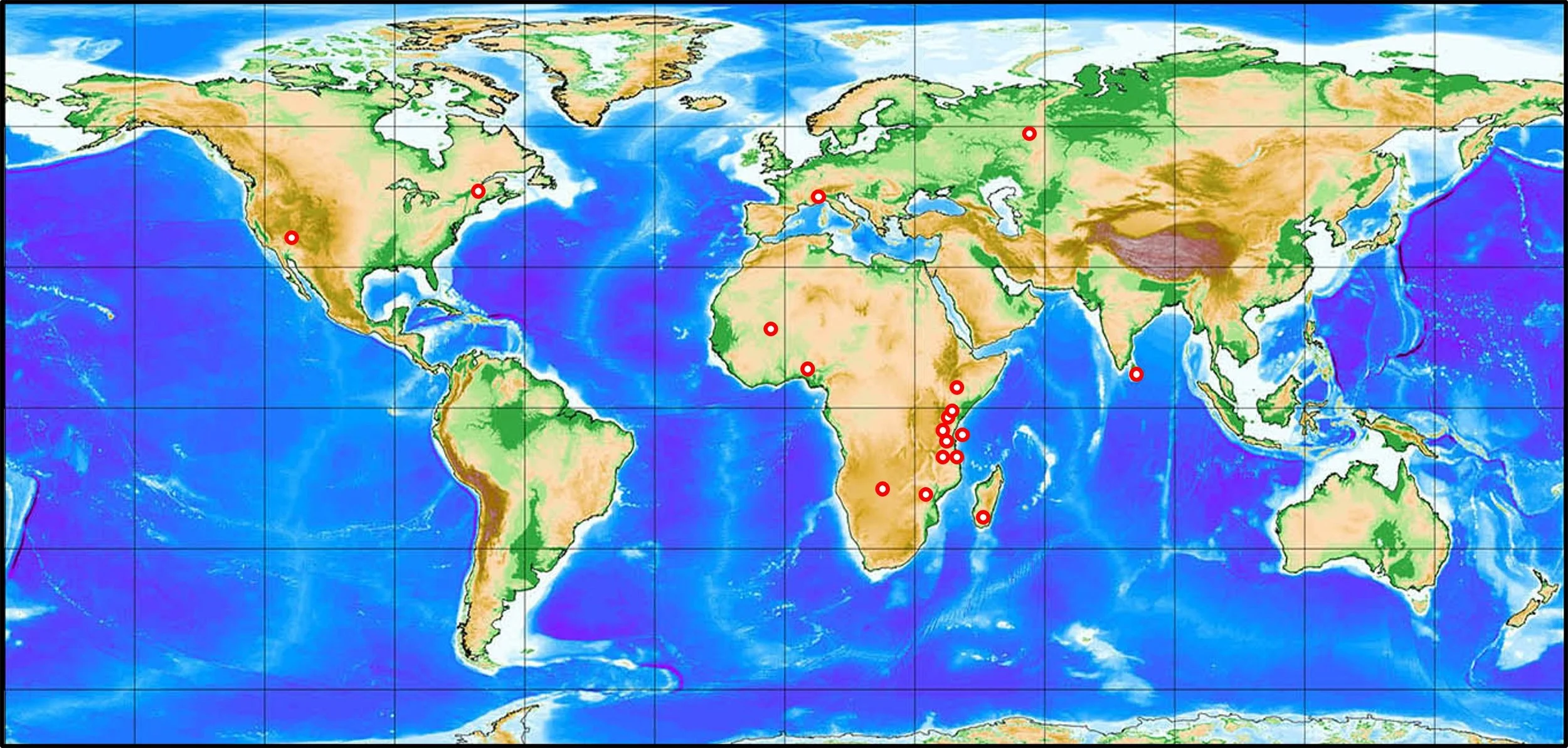
Map of mine localities from where the garnets in Garanatus came from.
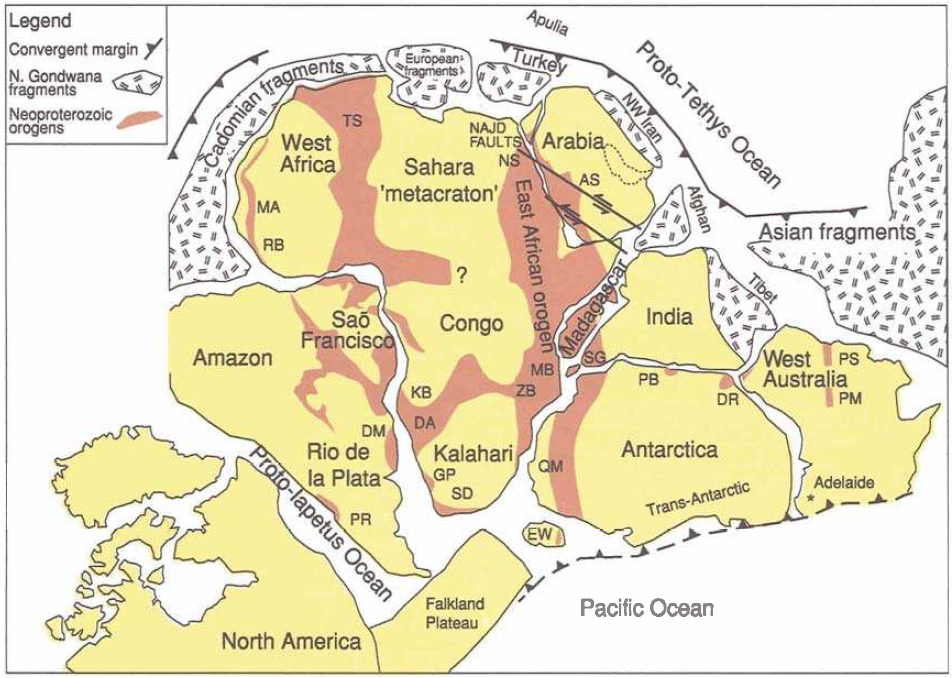
Reconstruction of the supercontinent of Gondwana (~540 million yrs ago), showing the major orogenic belts (mountains) from which many of the garnets formed.
REFERENCES
https://www.youtube.com/watch?v=jlgVxMrQzVU
https://www.maryvanderaa.com/garanatus-by-maryvanderaa
https://www.gia.edu/gems-gemology/spring-2024-in-the-spotlight
https://ui.adsabs.harvard.edu/abs/2025EGUGA..2713122T/abstract
https://iugs-geoheritage.org/geoheritage_sites/the-ultrahigh-pressure-unit-of-the-dora-maira-massif/
https://www.ssef.ch/anthill-garnets-from-arizona/
https://earthwonders.com/guides/jeffrey-mine_canada_121627
https://www.alexstrekeisen.it/english/meta/rodingite.php
https://www.gemsociety.org/article/spessartite-garnet/
https://www.gia.edu/gems-gemology/fall-2016-gemnews-purple-pyrope-almandine-garnet-mozambique
https://www.gia.edu/dam/migrated-assets/docs/doc1/WN99A4.pdf
https://www.langantiques.com/university/demantoid-2/
https://www.theraregemstonecompany.com/gemology-articles/color-change-garnet-from-kenya
Schwarzinger, C. (2023). Colour-Change Garnet Showing Blue Colouration from Kamtonga, Kenya. The Journal of Gemmology, 38(6), 545-548. https://doi.org/10.15506/jog.2023.38.6.545a
Sripoonjan, Tasnara & Maneekrajangsaeng, Marisa & Jakkawanvibul, Jirapit & Leelawatanasuk, Thanong. (2016). A New “Purple Rhodolite” Garnet from Mozambique: Its Characteristics & Properties.